Choosing a new road bike 1: Trek Madone SL 6 AXS Gen 8
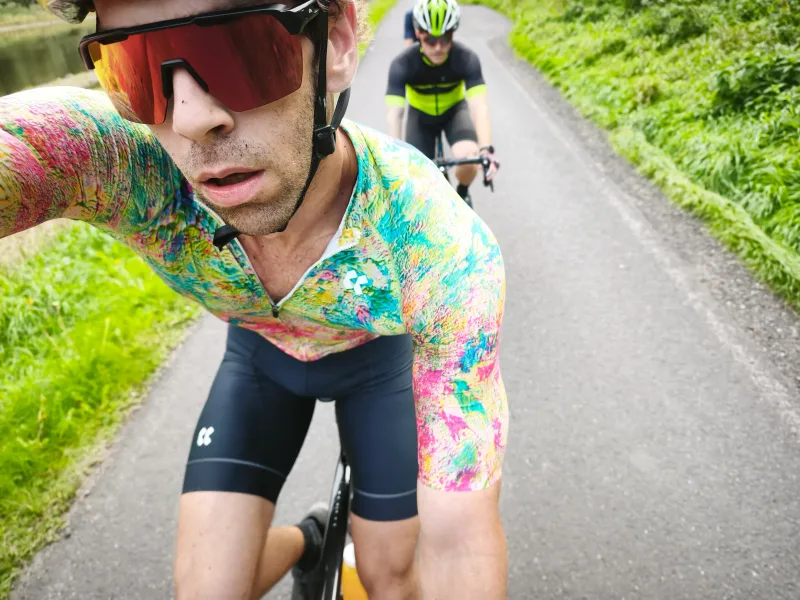
I’m choosing a new road bike and documenting the whole process here. In this instalment, I describe my experiences with the bike I’ve been riding so far and provide a structured review of the first contender for my new road bike – the Trek Madone SL 6 AXS Gen 8.
Author Aura XR 5 (2023)
As I wrote in the prologue, I’ve been riding an Author Aura XR5 since 2023. At the time, it was on sale at a retail price of 39,990 Kč; I managed to negotiate a price of around 29,990 Kč.
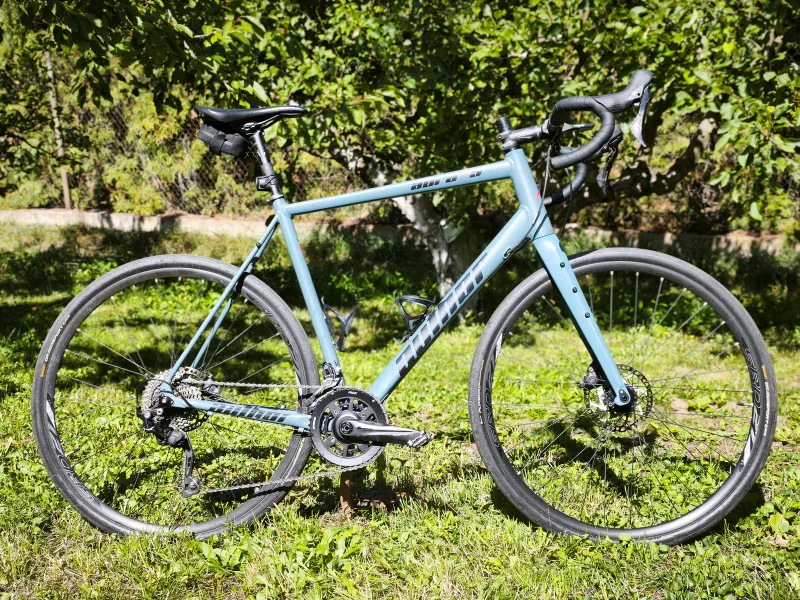
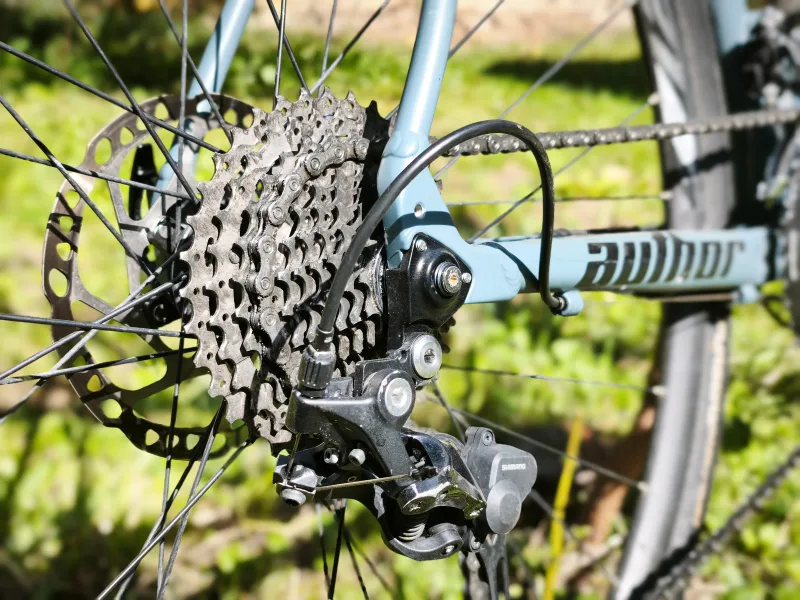
It has an aluminium frame with a carbon fork, fitted with a Shimano GRX400 2x10 groupset (46-30, 11-34 cassette), and hydraulic brakes from the same series. Total weight approx. 10.5 kg.
I haven’t had the chance to compare it with any other bike with drop handlebars since then, so my view is rather one-sided. I didn’t really get to ride the bike properly until 2024. I soon realised that I particularly enjoy riding on the road, where it’s smooth, where you can really fly along, and where I can find a steady pace and just pedal. I came to this definitive conclusion in September 2024, when I took part in the Gravel Blinduro gravel race – I want to ride on the road, and since then, with a few exceptions, that’s all I’ve done.
The Aura XR5’s geometry is closer to a sportier riding style – which is why I bought it in the first place – so it’s probably closer to a road bike than one designed for off-road riding.
My experience with the new bike took an unpleasant turn shortly after I bought it. The bottom bracket started to develop play and the right-hand crank wasn’t working as it should. It soon became clear that Author had a manufacturing fault or a faulty part and was issuing a blanket recall of all bikes in the series for a warranty claim (replacement of the cranks and bottom bracket). So I received new cranks and a new bottom bracket, but the warranty process took about 30–40 days. I didn’t mind, as I’d just had shoulder surgery anyway, but it certainly put a damper on my first impression.
Over time, I encountered several issues with the bike:
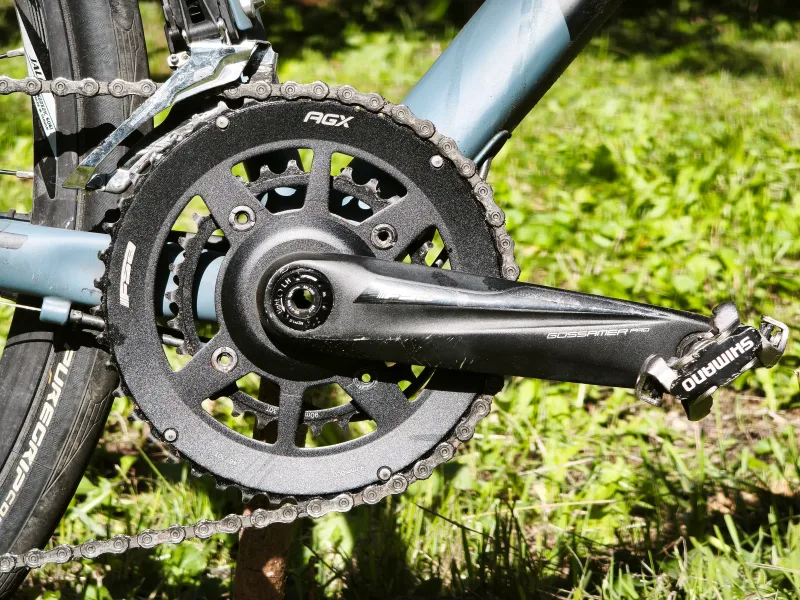
- Loose and stripped bolts on the large chainring, which caused it to bend. The service centre managed to straighten it out more or less, but it was never quite straight again until I replaced the chainring with a new one.
- The bottom bracket still creaks and squeaks to this day; the last mechanic said the bike was ‘rubbish’ and that the parts were of poor quality. According to him, after three years’ use, the bottom bracket has already used up more than half its lifespan – and judging by the noises it makes, perhaps even more.
- A snapped gear cable. Replacing it was, according to the mechanic, “a nightmare”, because everything is routed internally. I’ve no experience with that and don’t want any either.
- The brake pads on the rear brake came loose and popped out whilst I was riding. I didn’t really understand how that was even possible, and neither did the mechanic who subsequently fixed it, but it happened. Fortunately, it happened literally right outside my house after I’d finished riding on a very hilly route.
- Replacement of the brake disc
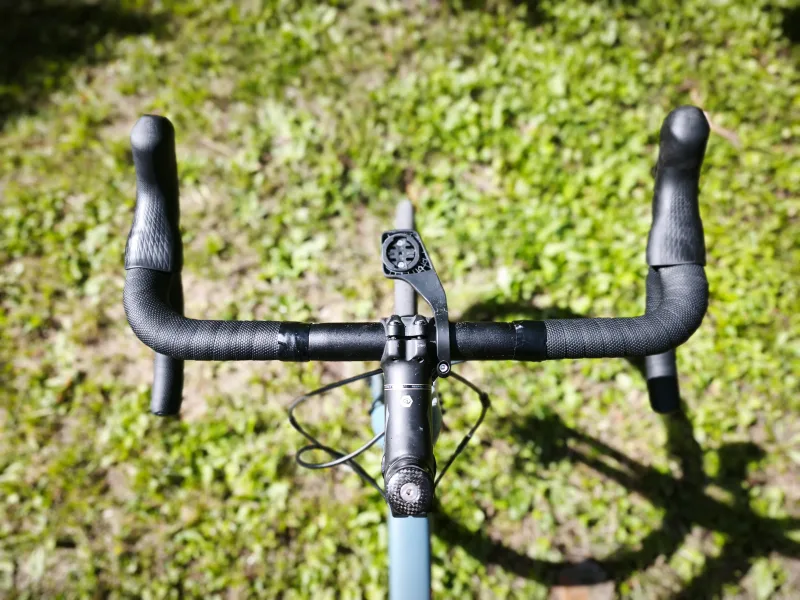
Over time, I turned this gravel bike into a sort-of road bike with a few minor tweaks. I bought road tyres – the narrowest the original rims would allow (32 mm) – and lowered the handlebars as much as possible. What had bothered me from the very first year was the relatively wide handlebars (46 cm on my size 58 frame).
The bike rode ‘well’ for me, simply because I didn’t know any different and had nothing to compare it with. At times, my hips would ache on the left or right side (I suffered from this chronically, though I’ve only managed to eliminate it in recent years through appropriate exercise), and my hands would go numb in places, but apart from fiddling about with the riding position a bit, I didn’t do much about it; I took it as the price to pay for a sportier bike. After all, the more I rode, the less these issues bothered me. Perhaps there’s something to it; it isn’t, by design, the most comfortable bike.
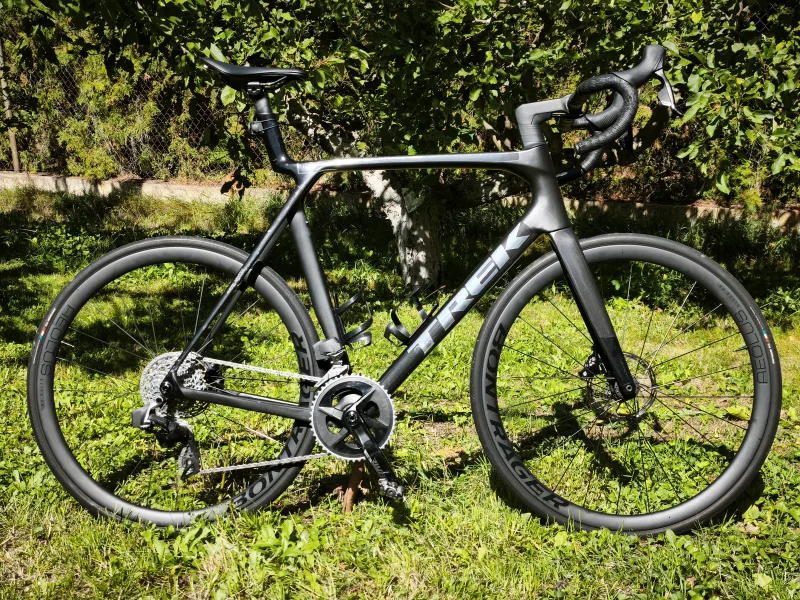
Trek Madone SL 6 AXS Gen 8
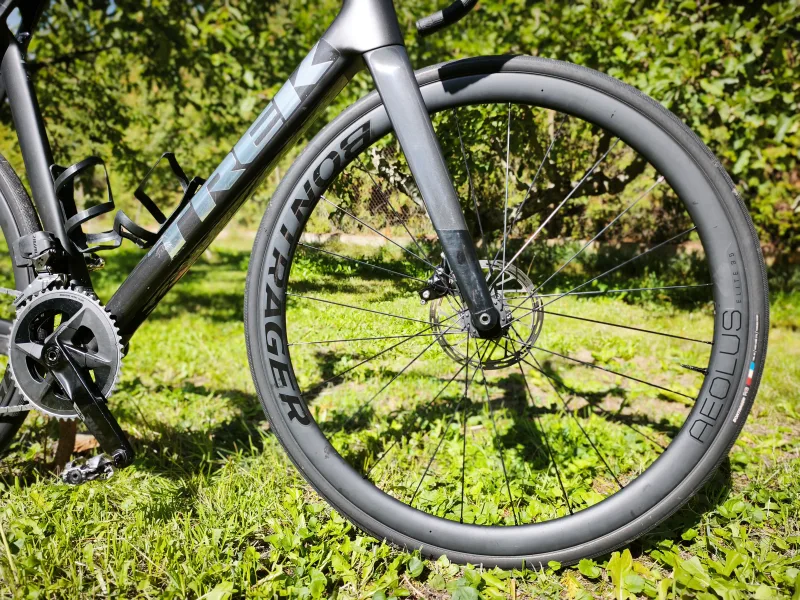
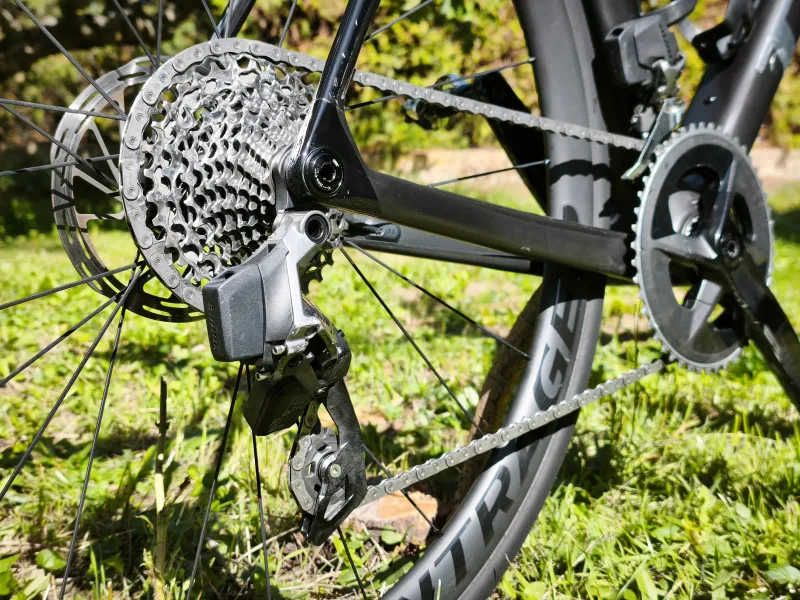
A few weeks ago, I borrowed this road bike for the weekend. Electronic gear changes, carbon frame, SRAM Rival AXS 2x12 electronic groupset, weight approx. 8.5 kg. The weight was the first thing that really surprised me compared to my gravel bike. You’d think it’s ‘only’ a 3 kg difference, but as soon as I picked the bike up, I could really feel the difference. If you forget about the kilos, in absolute terms that’s almost 25 % of the weight. And that’s simply no small thing.
In this configuration, it retails for around 125,000 Kč. Even as I was walking the bike from the hire shop to my car – a distance of about 300 metres – I had a feeling this was going to be something special.
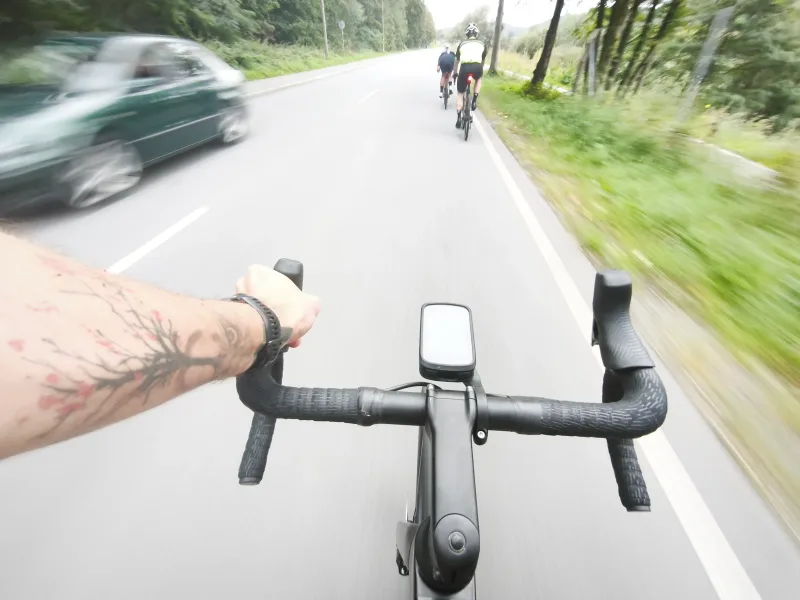
The next day, I took it out on a 112 km ride. And what an experience it was for me! As I’ve said, I’d never ridden any bike with drop handlebars other than a cheap Author, so I had nothing to compare it with. I suspected there’d be a marked difference, but this exceeded my expectations.
It’s simply a sharp road bike, and so everything associated with it was new to me: the stiffness of the frame, every pedal stroke immediately translating into the bike’s eagerness to surge forward. This also comes with a certain degree of discomfort (due to the narrower 28 mm tyres and the bike’s overall stiffness) and an aerodynamic riding position enhanced by the narrower handlebars – by default, you sit on it in a slightly more hunched, crouched position. The electronic gear-shifting is absolutely brilliant; I’m sure I’ll definitely want it on my next bike. The bike’s gearing is, logically, better suited to speed and road conditions, and when riding downhill, you no longer find yourself running out of gears at around 55 km/h with nothing left to push with. Accelerating from 30 km/h to 40 km/h feels much easier and more direct than on a gravel bike.
That aerobic feel and the lack of comfort didn’t bother me at all. On the contrary, this riding style suited me perfectly and it simply felt brilliant; I got exactly what I imagine a road bike’s sportier ride to be like from this bike. Even after more than 4 hours of riding, I wasn’t suffering in any way, although my right elbow did bother me slightly in places – which I put down more to the bike’s stiffness (a couple of sections were on cobbles and it was noticeably more jarring than on a gravel bike). On the contrary, I felt like carrying on, and if it hadn’t been almost dark, I probably would have.
The bike exuded premium quality from every part, at least compared to my gravel bike. Nothing creaked or squeaked; there was no play, twisting, or lag – nothing out of place.
In short, it was a truly exclusive experience, a bit like when someone who drives an old Škoda suddenly gets into a new Mercedes. I realised straight away that the desire to buy a new bike is, admittedly, a bit of a whim in the sense that it won’t replace your legs, but the feeling and joy of riding that I got from it are absolutely sufficient reason to want a similarly expensive bike.
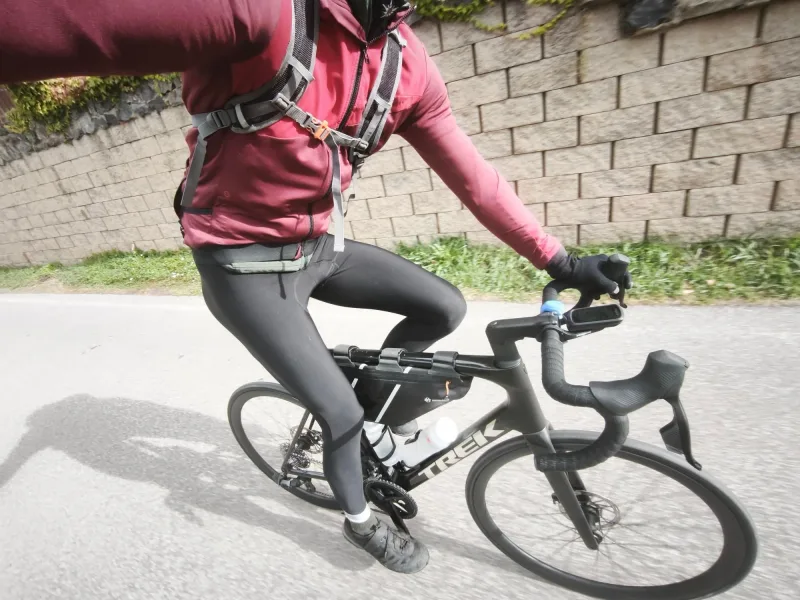
I subsequently completed a second, roughly 76 km-long ride to Prague on the bike, but this time with a load. I was carrying a rucksack with my laptop and a frame bag with a change of clothes (see the last photo). It didn’t make much difference to how the bike felt, but logically it was more of a transport ride than a proper test.
Scorecard
With some help from AI I put together a scoring framework. Every bike I get to test goes through it. It has three parts: hard facts, the gate, and the scores. A verdict closes it. No weighted total, no single magic number. You can add it up yourself. I will decide with my head and my heart, and show why.
Facts
| Author Aura XR 5 (2023) | Trek Madone SL 6 AXS Gen 8 | |
|---|---|---|
| Price | CZK 29,990 (list CZK 39,990) | approx. CZK 125,000 |
| Frame / fork | triple butted 6061 alloy / carbon | 500 Series OCLV carbon / carbon |
| Size, stack / reach | 580 mm, 627 / 397 mm | XL, 610 / 402 mm |
| Wheelbase | 1,046 mm | 1,007 mm |
| Weight (with pedals) | approx. 10.5 kg | approx. 8.5 kg |
| Groupset | Shimano GRX 400, 2x10, mechanical shifting, hydraulic brakes | SRAM Rival AXS, 2x12, electronic shifting, hydraulic brakes |
| Crankset, bottom bracket | FSA Gossamer Pro 46/30, FSA BB-6000 | SRAM Rival AXS 48/35, DUB T47 |
| Cassette | Shimano HG500 11-34 | SRAM XG-1250 10-36 |
| Hardest / easiest gear ratio | 4.18 / 0.88 | 4.80 / 0.97 |
| Power meter | no | yes, SRAM Rival AXS in the crank |
| Wheels | JALCO SRD 21 alloy, QUANDO hubs, 32 spokes | Bontrager Aeolus Elite 35 carbon |
| Tyres | road 32 mm (stock Panaracer Gravel King 38 mm) | Bontrager R3 28 mm (max 32 mm) |
| Bars, stem | PROMAX alloy 46 cm, slammed as low as it goes | Bontrager Comp alloy, 42 cm at the hoods / 46 cm in the drops, 110 mm stem |
| Test rides | 3 seasons, approx. 9,000 km | 112 km proper test + 77 km to Prague with a backpack and a frame bag |
Gate
Three yes/no questions. If a bike fails one, there is no point scoring it.
| Aura XR 5 | Madone SL 6 | |
|---|---|---|
| Fits me in a racing position | not really (46 cm bars, taller stack, no room to go lower) | yes, 4 h+ without suffering |
| Within budget | yes | yes, but right at the limit |
| Available in my size for the season | yes | ? |
Scores
Six criteria, 1 to 10, no weights. 1 to 3 is bad and I would not buy the bike because of it. 4 to 5 is acceptable, nothing more. 6 to 7 is good, no complaints. 8 to 9 is clearly better than the rest. 10 means I cannot imagine better.
| Criterion | Aura XR 5 | Madone SL 6 | Why |
|---|---|---|---|
| Speed on the flat | 4 | 8 | Going from 30 to 40 km/h is more direct on the Madone. Aero position, narrower hoods, stack 17 mm lower. On the gravel bike I run out of gears at 55 km/h downhill. The Madone’s top gear is 15 per cent taller. |
| Climbing and acceleration | 4 | 8 | Stiff frame, 2 kg lighter. Every pedal stroke goes forward. The easiest gear is slightly harder than on the Aura. It did not matter on the test. |
| Handling and descending | 5 | 7 | Two rides on the Madone, nothing surprised me. Same behaviour with a backpack and a frame bag. The Aura has a longer wheelbase and wide bars. Stable, but lazy. |
| Comfort after 2 h | 5 | 6 | Aura: lower back, numb hands, but 32 mm tyres. Madone: harsher, cobbles come through, right elbow. After 4 h I still wanted to keep riding. 77 km with luggage, no problem. |
| Groupset, wheels, build quality | 3 | 8 | Aura: recall on the FSA cranks and bottom bracket, bent chainring, bottom bracket still creaks, brake pads fell out, shift cable snapped in internal routing. Madone: no creaks, no play, electronic shifting, carbon wheels. Rival is entry-level AXS and the cockpit is alloy, so not a 9. |
| Value for money | 5 | 6 | The Aura was cheap, but servicing made it expensive. The Madone costs 4x more and sits right at the top of my budget. Power meter, carbon wheels and electronic shifting are included. Whether the price is fair will show once I compare it with the others. |
Verdict
| Aura XR 5 | Madone SL 6 | |
|---|---|---|
| Best thing about it | It got me onto the road and in three years showed me what I want. | The ride. Stiffness, shifting, and the urge to keep going after 4 hours. |
| Deal breaker | Component quality and servicing. | Price. CZK 125,000 is my ceiling, and for that you get entry-level Rival and an alloy cockpit. |
| Would I buy it | no | maybe (yes, if the other candidates do not bring more for the same or less money) |